

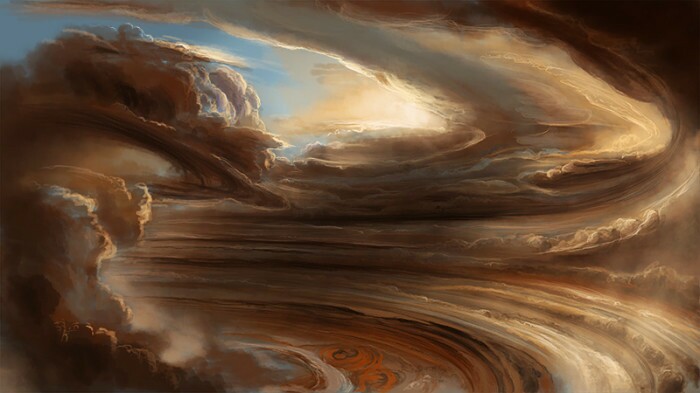
Jupiter's atmosphere is very active, with numerous storms, vortices, and other atmospheric phenomena. It consists mainly of hydrogen and helium, with small amounts of other gases such as methane, ammonia, sulfur, and water. It is divided into several layers, each with its own unique characteristics.
The upper stratosphere contains layered clouds composed of ammonia and ammonium hydrosulfide. Here, the temperature increases with altitude. The stratosphere also contains bands of clouds that are visible in photographs of Jupiter.
Below the stratosphere lies the mesosphere, where the temperature begins to decrease again with depth. This is also the region where a large number of storms and vortices occur.
The lower part of the atmosphere is the troposphere. This layer contains most of the clouds and has the highest wind speeds—up to 600 km/h. The troposphere transitions into a deep layer called the stratosphere, where the temperature remains relatively stable.
Below the stratosphere lies a layer known as the zone where the temperature gradient becomes negative. Below the zone lies the molecular core, where pressure and temperature reach extreme levels. Jupiter’s
core, which is one and a half times the size of Earth, is believed to be rocky, although it has never been observed directly.